Are you looking for mind-blowing facts on mountain gorillas or interesting facts about all the gorillas in Africa? Look no further than this article that will give you an insight into these primates.
They are Africa’s living primates that are closely related to humans, with about a 98% DNA match. These primates are known to live in the protected tropical forests of equatorial Africa.
Their status as the largest living primates, profound genetic similarity to humans, and being the critically endangered, charismatic, gentle giants make them the most searched for on earth when it comes to primate safaris in Africa.
Key insights into the facts on gorillas in Africa
- Detailed overview of the top gorilla facts, including their social structure, size, diet, among others, which makes them very unique primate species.
- Some of the gorilla conservation efforts that are being implemented in Rwanda
- Additional information on gorilla tours in Africa, packing lists, and best tour operators which organising these safaris
Below is a detailed overview of interesting facts about gorillas in Africa.
The following are some of the top gorilla facts that you should know before your gorilla tours in Africa:
Gorilla Species and Subspecies in Africa

The genus Gorilla is divided into two species, which are the western gorillas, scientifically named “Gorilla gorilla,” and the eastern gorillas, “Gorilla beringei.” Each of the two species is divided to form the other four gorilla subspecies.
These two species are also known to be living in the dense Congo Basin forest, and they are separated by roughly 560 miles.
Western Gorilla (Gorilla gorilla)
The two subspecies of the western gorilla include
Western Lowland Gorilla Subspecies
The western lowland gorillas live in Gabon in Loango National Park and in the Republic of the Congo’s Odzala-Kokoua National Park.
Cross River Gorilla
The western cross river gorillas are the world’s rarest great apes, with an estimated population of 200-300 individuals, inhabiting a small area between Nigeria and Cameroon.
Eastern Gorilla (Gorilla Beringei)
The two subspecies of the eastern gorilla include
Mountain Gorilla (Gorilla Beringei Beringei)
These gorilla species inhabit the high-altitude volcanic forests of Rwanda’s Volcanoes National Park, Uganda’s Bwindi Impenetrable National Park and Mgahinga National Park, and the DR Congo’s Virunga National Park.
They are known for their thick dark fur that keeps them warm in their high-altitude habitats.
Eastern Lowland Gorilla/Grauer’s Gorilla (Gorilla Beringei Graueri)
These are the largest subspecies of the Gorilla beringei, and they are restricted to the Kahuzi Biega National Park in the Democratic Republic of the Congo.
Social Structure of the Gorillas
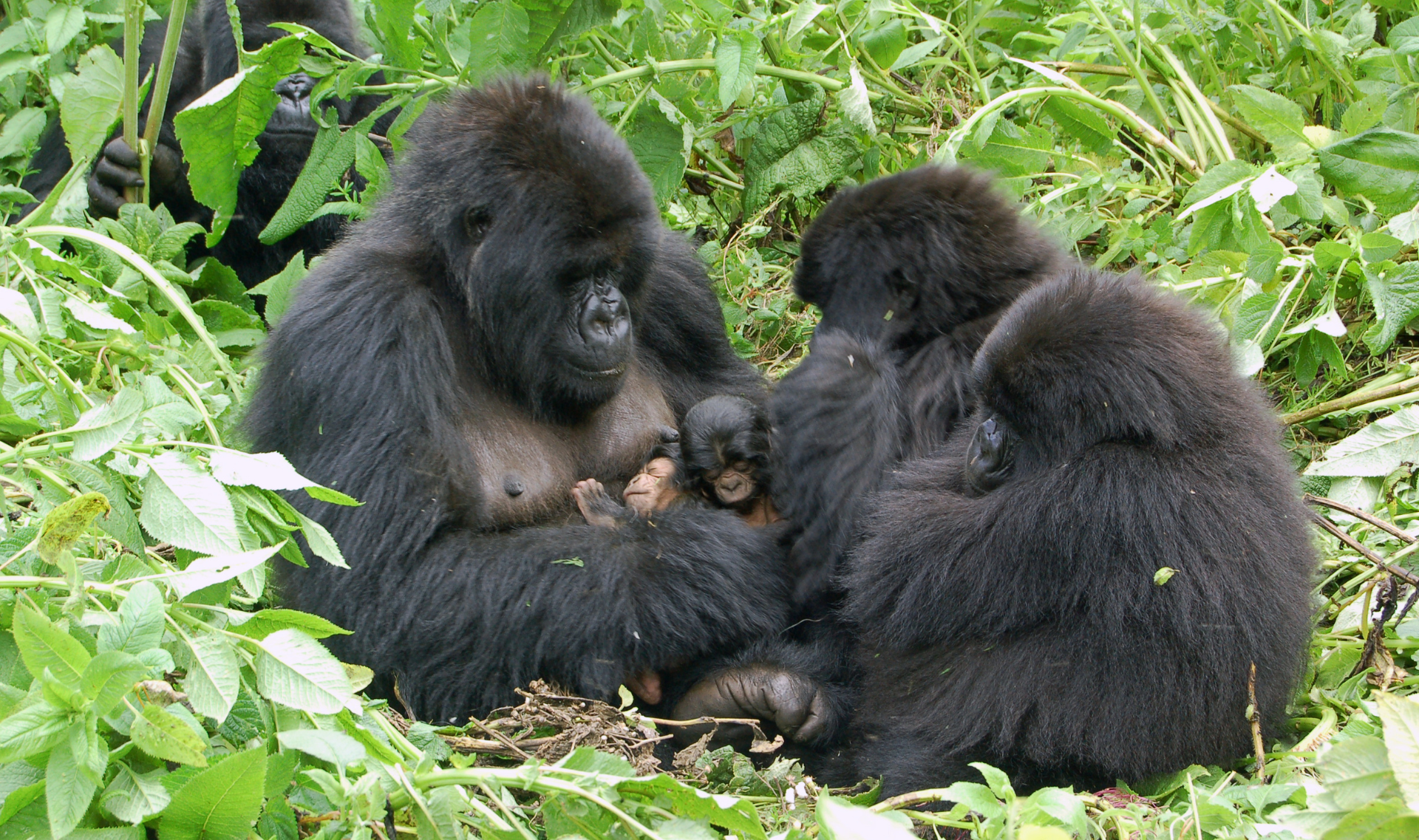
Gorilla beringei beringei and other subspecies live in groups (troops), which vary from 5 to 50 members. The silverback leads the troop and can retain his position for many years.
The troop of these social animals may comprise 1 to 4 silverback males, adult females, blackbacks, juveniles, and young ones.
Adult males usually leave their birth group upon reaching maturity to establish their own ranges, and the mature females leave their family to join other gorilla groups or single males.
The troop’s dominant male (silverback) is responsible for making major decisions for the group, such as new locations where there is plenty of food.
The silverbacks are very aggressive males who will attack anything that comes near their family. He screams and beats his chest to show he is the boss.
Communication
Gorillas communicate using a range of vocalizations and displays to maintain social hierarchies in their troops.
Chest beating is commonly used by both males and females for intimidation and communication, although it is commonly associated with the silverbacks.
Gorilla Diet and Feeding Habits
Gorillas typically travel a few hundred meters between their daily feeding bouts. Their feeding routine generally consists of foraging in the morning, followed by a long resting time around midday, and further feeding before resting on their new nests.
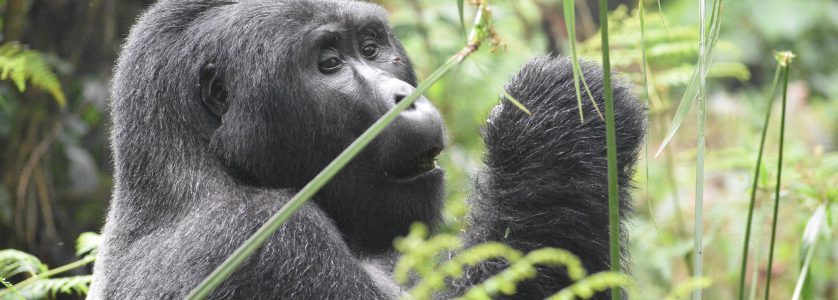
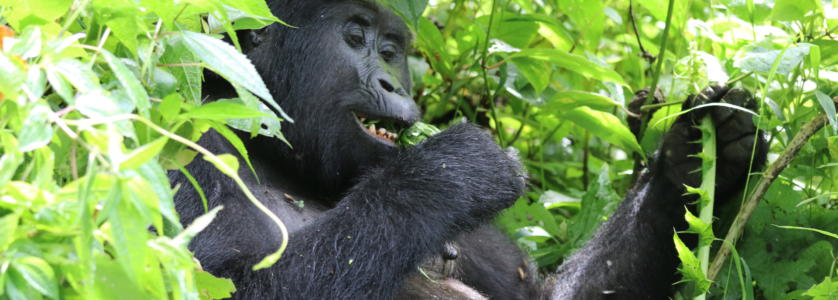
The diet of Gorilla beringei mainly includes tree bark, leaves, stalks, and shoots from the bamboo forests, while Gorilla gorilla eats more of fruits.
Gorillas eat more than 40 pounds of vegetation per day. In their routine movement in search of food, they play a vital role in forest health by spreading seeds through their droppings.
Some of these great apes also break open termite nests to feed on larvae.
Size and Weight
The average height of an adult male gorilla is 4 to 6 feet, and that of a female is around 5 feet.
Grauer’s gorillas are said to be larger and heavier than Gorilla beringei beringei.
The adult eastern lowland gorillas weigh 130 and 210 kg (286–463 lbs), and the females weigh around 81–90 kg (178–200 lbs).
The adult male mountain gorilla weighs around 150–195 kg (330–430 lbs), and the females weigh around 90 kg (200 lbs).
Physical Appearance of Gorillas
Gorillas are the largest primates in the world, with broad chests and shoulders.
They have a large stomach, which is attributed to their enlarged intestines, which digest the vegetation they continuously consume.
They also have human-like hands and small eyes set in a hairy face, which also looks more or less like those of humans.
Since gorillas are the largest primates, they possess muscular arms significantly longer than their legs, compelling them to use a specialized form of quadrupedal locomotion known as knuckle-walking.
Their skin is dark and covered with black to brown-grey fur. The eastern gorillas appear to be darker than the western gorillas.
Reproduction and Breeding
The female gorillas reach their sexual maturity at the age of 6 to 8 years, from which they start breeding for several years.
At her sexual maturity, she will leave her own family to go to another family or a lone silverback to live with.
Female gorillas give birth to one young one at a time but sometimes to twins, though very rarely, and at birth, the baby gorilla weighs only 3 to 4 pounds, which is almost half the weight of a human infant.
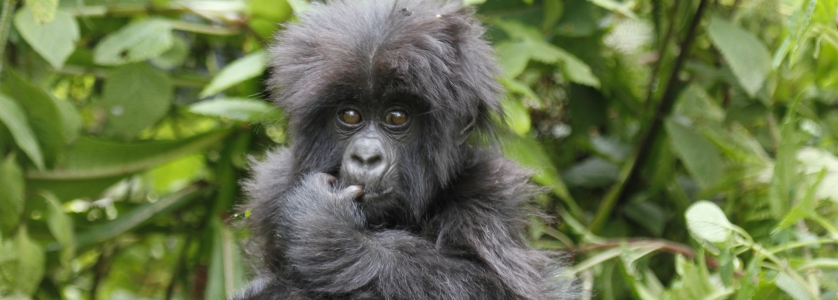
Infants have a close relationship with their mothers through physical contact for 5 to 6 months. They start crawling and clinging to their mother’s back at 2 months and walking at 9 months.
A young gorilla is nursed for three years, and the two continue to share the nest until the juvenile is 6 years old.
These great apes also grow fast compared to humans, and they reach maturity at the age of 12 years.
The Lifespan of the Gorillas
The life expectancy of wild gorillas is about 35 to 40 years, but captive gorillas can live up to 50 years or older due to improved nutrition, veterinary care, and safety.
The Intelligence Level of Gorillas
Gorillas are highly intelligent creatures and can learn sign language from humans. Research has shown that these primates can express sign language and express wants and descriptions of their environment.
They express a range of emotions, from laughter during play to grieving for the dead.
These gentle giants have been witnessed using a range of tools, from sticks to measure the depths of rivers and water in the swamps to using twigs for scooping up food and creating wooden bridges, among others.
They can also recognize their image in a mirror, which indicates a sense of self-awareness. However, this is less consistent than that of chimpanzees.
Threats to Gorillas
As the human population grows, the expansion of agriculture and charcoal production is rapidly destroying gorilla habitats, and this is the biggest threat to these great apes.
Besides habitat loss, another threat that gorillas face is poaching for bushmeat, which is seen as a high-end, prestigious food item among the wealthy in some urban centers.
Both eastern and western gorillas are affected by diseases, including invasive diseases of human origin.
The Ebola virus recently decimated the gorilla population, and this is partly because these creatures share approximately 98% of their DNA with humans, but they often lack developed immunity, leading to high mortality and morbidity.
Gorilla Conservation Efforts
- Conservation efforts are improving the situation for some gorilla populations, such as the mountain gorilla, which I recorded to be around 1063 individuals in the wild.
- Conservation organizations are working to promote public awareness about gorilla protection.
- There is ranger-led monitoring and anti-poaching, where over 1000 rangers conduct daily patrols to remove snares, monitor gorilla health, and curb illegal activities.
- Encouraging donations to conservation organizations that are working to protect the gorillas. Organizations, including the World Wildlife Fund, the Dian Fossey Gorilla Fund, and Gorilla Doctors, have been on the ground finding effective ways of conserving these great giants using the donated funds.
- There is transboundary collaboration where organizations like the International Gorilla Conservation Program (IGCP) coordinate efforts between Uganda, Rwanda, and DR Congo to ensure that these primates are protected even when they cross borders.
- Sustainable agriculture, supported by public health initiatives like CTPH, offers local communities an alternative livelihood, reducing their dependence on forests.
What Is the Best Time to See Gorillas?
The best time to see these gentle giants in all countries is during the dry seasons when the trekking trails are dry, allowing trekkers to move more comfortably and predictably through forest terrain.
However, some travelers can do gorilla tracking during the wet season, especially those with a low budget.
What to Pack for Interesting Gorilla Safaris?
- Hiking shoes with a good grip
- Garden Gloves
- Rain Jacket
- Long-Sleeved Shirt or Jacket
- Long trousers
- Short-Sleeved Shirt
- Hat and sunglasses
- Long socks
- Cameras and extra batteries
- Pair of binoculars for extra activities like birding
- Insect repellent
- Packed lunch and snacks
- Water
- Toiletries like bathing soap, body cream, toothpaste, and toothbrushes, among others.
Best Tour Operators to Organize Interesting Gorilla Tours in Africa
The following are the best tour operators known for organizing interesting gorilla tours
- Prime Safaris And Tours Ltd
- Wild Gorilla Safaris
- Gorilla Safari Rwanda
- Rwanda Gorilla Tracking Safaris
- Gorilla Tracking Rwanda
- Africa Safaris Tours
- Gorilla Safaris And Tours
- Safari Uganda Safaris
- Gorilla Safaris And Tours
- A Uganda Safari
- Uganda Birding Safaris
- Gorilla Trekking Uganda
- Congo Gorilla Safaris and Tours
Interesting Facts about Gorillas in Africa FAQs (Frequently Asked Questions)
How Intelligent Are Gorillas?
Gorillas are very intelligent primates, and they rank among the smartest animals with cognitive abilities similar to those of humans.
They have self-awareness (passing the mirror tests), they use sticks to measure the depth of water, and they can communicate with more than 25 distinct vocalizations.
What Is Special About Gorillas?
Gorillas are a very unique primate species with high intelligence and distinct biological traits, including a nose print, which works like a human fingerprint.
They also share approximately 98% of their DNA with humans, making them our closest relatives after chimpanzees and bonobos, and the majority of them live in tightly bonded family groups led by a silverback.
How Many Gorillas Are Left?
There are about 316000 Gorilla gorilla, over 1063 Gorilla beringei beringei, and 5000 Gorilla beringei graueri left in the world.
4. What Are 10 Gorilla Facts?
- Gorillas share around 98% of their DNA with humans.
- They eat all day long.
- They cozy up at night.
- They are the largest and most powerful primates on earth.
- Mountain gorillas live in stable family groups with around 10 individuals or more, with a leading gorilla called a silverback.
- They are critically endangered due to habitat destruction and poaching.
- They have a nose print just like humans have a fingerprint.
- They are intelligent and use different methods to communicate, including signs.
- They build nests almost every day out of leaves and branches, either on the ground or in trees.
- Female gorillas produce at the age of 10 years, and their gestation period is 8 to 9 years.
How Much Can a Gorilla Lift?
Gorillas are 4 to 9 times stronger than an average human, and a fully grown silverback can lift approximately 815 kg of dead weight.
They can bend iron bars, tear down banana trees, bite with more power than a lion, and they are so aggressive when threatened.
What Is a Female Gorilla Called?
There is no specific term for the female gorilla, like there is for the young adult males called blackbacks and the fully grown male gorillas, the silverbacks, whose backs have turned silver in color.
How Many Stomachs Does a Gorilla Have?
Gorillas have one stomach as opposed to many other herbivores with four chambers.
Are There Only 1,000 Gorillas Left?
There are more than 1,000 gorillas left in the world. There is an estimate of more than 1,063 Gorilla beringei beringei, around 6,000 Grauer’s gorillas, and over 360,000 Gorilla gorilla gorilla in West and Central Africa.
What Do Gorillas Do for Fun?
Gorillas have a lot of fun since play is seen most often among the juveniles and infants as they make their first moves away from their mothers.
Which are the two subspecies of the Eastern Gorillas?
There are two widely recognized subspecies of eastern gorilla, which are the
- The eastern lowland gorilla (Gorilla beringei graueri) in the eastern Democratic Republic of the Congo
- Eastern mountain gorillas (Gorilla beringei beringei) in Uganda, Rwanda, and the eastern Democratic Republic of Congo
Where Are the Western Lowland Gorillas Found?
The western lowland gorilla lives in the forests and low-lying swamplands in Equatorial Guinea, Gabon, Cameroon, Angola, DR Congo, and the Central African Republic.
Contact us now to help you book your African gorilla safari and have a chance to encounter the world’s largest primates in their respective families in their natural habitats.
 >
>