Home » RWANDA NATIONAL PARKS: NATIONAL PARKS OF RWANDA RWANDA NATIONAL PARKS: NATIONAL PARKS OF RWANDA
National parks in Rwanda are well-protected wildlife areas and breathtaking ecosystems worth exploring during African safaris. There are four national parks in Rwanda: Volcanoes National Park, Akagera National Park, Nyungwe Forest National Park, and Gishwati Mukura National Park, which offer diverse ecosystems and unique wildlife viewing opportunities.
The national parks or wildlife reserves are maintained and cared for by the Rwanda Development Board (RDB), with assistance from other government departments.
In addition, RDB promotes Rwandan parks with their unique fauna and ecosystems present in each park.
In Africa, Volcanoes NP in Rwanda is the oldest and busiest park. It borders Uganda, the Democratic Republic of the Congo, and the Virungas.
Mountain gorillas only exist in this Rwanda safari park in conjunction with gorilla parks in neighboring countries like Uganda and DR Congo.
In Volcanoes National Park, the gorilla population has been on the rise for the past two decades alongside other inhabitants, including golden monkeys.
Nyungwe Forest National Park, situated near the Burundi border in the southeast, is another renowned national park in Rwanda and the largest and oldest montane forest in Africa.
This park is an excellent destination for Rwanda chimpanzee excursions. In addition, this park is home to numerous primate types (13), such as blue monkeys, Red-tailed monkeys, silver monkeys, and Olive Baboons, among other primates.
Akagera National Park, the sole savannah park located on the eastern border of Rwanda, between Lake Victoria and Tanzania, is also eagerly awaiting your visit.
Giraffes, buffaloes, elephants, lions, cheetahs, zebras, and a variety of antelopes make up Akagera's diverse wildlife population.
Finally, the most recent park in Rwanda is Giswati Mukura National Park.
While all of the aforementioned Rwanda national parks are accessible year-round, the most optimal experience is enjoyed during the dry months, such as during Rwandan gorilla excursions.
It is feasible for travelers to incorporate all of these parks into their Rwanda safaris during their vacation in the Land of a Thousand Hills—Rwanda.
The different national parks in Rwanda are listed below:
National Park of Akagera
Rwanda’s northeastern region is home to Akagera National Park, one of the best Rwanda national parks worth exploring for all of the Big Five fauna it packs during Rwandan safari holidays.
As the largest national park in Rwanda, this single savannah national park spans approximately 1,085 km².
The name “Akagera” is derived from the Akagera River, which is included in Rwanda’s Akagera Park and borders Tanzania. The river supplies water to a dozen lakes within the park, including Lake Ihema.
This national park was established in 1934 to safeguard the vegetation and animals of three distinct habitats: the savannah, mountain, and wetland.
More than 480 bird species and approximately 1000 animals, including all of the African Big Five—Lion, Cape Buffalo, Elephant, Leopard, and Rhino—are documented within Akagera National Park, Rwanda.
Most game animals in Akagera are observed during game excursions in the savannah grasslands and woodlands.
Note that Akagera Park was devoid of Lions in the years preceding 2015. However, the African Parks management relocated seven Lions to this protected area in order to enhance the diversity of wildlife in the park.
This savannah ecosystem is currently under the jurisdiction of the Akagera Management Company, which is a subsidiary of the Rwanda Tourism Board, the government of Rwanda.
Wonderful Tourist Attractions in Akagera National Park

Wild Animals: Such as large herds of Zebras, Cape buffaloes, Elephant herds, Cheetahs, Black Rhinos, Leopards, Golden cats, Serval cats, Elands, and Impalas, are among the many others. Please note that Akagera is the only place in Rwanda where tourists can see the Big Five.
Avians: The Lilac-breasted Roller, Black-headed gonolek, White-browed coucal, African fish eagle, Double-toothed barbet, and Marsh Tchagra are among the common avian species found in Akagera.
Lake Ihema: Although Akagera National Park contains numerous water bodies, Lake Ihema is the most renowned. The lake is home to a variety of water avifauna, as well as hippos and numerous crocodiles.
Most Popular Activities in Akagera National Park, Rwanda
- Game Drives: While on a game drive through the savannah expanses, you will have the opportunity to observe a variety of game animals, including large zebra herds, buffalo, elephant herds, lions, black-spotted hyenas, and a multitude of antelopes.
- Birding: During Rwanda birding excursions, Akagera National Park is the sole national park where tourists can observe savannah avifauna totaling about 500 recorded birds, including the Double-toothed Barbet, Booted Eagle, Crested Barbet, and Martial Eagle.
The majority of birding excursions in Akagera National Park take place in the savannah woodland and along the Lake Ihema boat cruise. You can combine birding with tours that include wildlife observation in various park regions.
- Boat Cruises: The most successful Lake Ihema boat cruise for game viewing expeditions is conducted in the afternoon, when the majority of fauna congregates at the lake’s shores to consume water. Big Hippo colonies, crocodiles, and water avifauna are frequent inhabitants.
- Guided Nature Walks: This is a memorable expedition to investigate wild fauna, i.e., nature walking in Akagera Park. Be prepared to observe African Elephants, a variety of antelopes, giraffes, zebras, and buffalo on foot from a secure distance with a game ranger.
- Fishing: Although not as sought-after as game safaris in Akagera Park, this excursion occurs on Lake Shakani.
- Community & Cultural Tours: Community excursions are conducted in the vicinity of Akagera Rwanda Park, with tours conducted in local communities where inhabitants were former poachers.
Rwanda National Parks: Volcanoes National Park
Volcanoes National Park, also known as Parc National des Volcans in French, covers an area of 160 square kilometers.
Located in the northwest of Rwanda, it shares a border with Virunga National Park in the Democratic Republic of Congo and Mgahinga Gorilla National Park in Uganda.
In Rwanda, the sole location for gorilla trekking excursions among all the national parks in the country is Rwanda Volcanoes Park.
The maximum population of endangered mountain gorillas on Earth is found in Bwindi Impenetrable National Park in Uganda, followed by Volcano NP, Rwanda, and others in Virunga NP, Congo.
Mount Karisimbi, Bisoke, Sabyinyo, Muhabura, and Gahinga are five of the eight peaks that encompass the Virunga Massif in this scenic park in Rwanda.
This park was first gazetted by Rwanda’s government with the primary objective of protecting the endangered Mountain gorillas in 1925.
Key Attractions in Volcanoes National Park
- Mountain Gorillas: These are truly remarkable to observe in their natural environment during Rwanda gorilla trekking tours.
Giant mountain gorillas, listed as endangered by the International Union for Conservation of Nature (IUCN), are the largest primates on Earth, with an average weight of approximately 180 kilograms.
These great apes are referred to as the gentle giants due to their gentle nature, despite their immense weight and power.
Each gorilla family is commanded by a dominant male known as a Silverback, and these great apes live in families similar to humans, as seen during Rwanda gorilla tours.
- The Golden Monkeys: The Golden monkeys are the most attractive monkeys in East Africa. Worldwide, they are exclusively visible in the Virunga Mountains of Rwanda Volcanoes National Park and Uganda Mgahinga National Park.
- The Scenic Virunga Mountains: Volcano National Park is home to five volcanoes in the Virunga massif, with Mount Bisoke and Karisimbi being the most popular choices for hikers who visit Rwanda for hiking safaris.
- Tombs of Dian Fossey: Dian Fossey is a distinguished American primatologist who established a solid foundation for the conservation of gorillas. Around the tomb of this remarkable woman, you will observe the monuments of gorillas that were killed as a result of poaching, including Digit.
- Birds of Beauty: Rwanda Volcanoes National Park is home to approximately 200 types of avifauna in the country. These avians, including the Bar-tailed trogon, Rwenzori Turaco, Doherty’s bush-shrike, and Dusky crimsonwing, can be observed along the gorilla trekking trails.
- Caves of Musanze: These Musanze caves are mystifying and have a rich history that is well worth investigating during safaris.
- Twin Lakes or Ruhondo and Burera: These twin waterways are situated just outside the park.
- Gorilla Guardians Village: After the gorilla expedition experience, Iby’iwacu Cultural Village is an excellent destination for cultural encounters.
Major Activities in Volcanoes National Park, Rwanda
- Gorilla Trekking: Many travelers regard gorilla trekking in Volcanoes National Park as the most exhilarating game-viewing adventure in East Africa.
It presents a wonderful opportunity to encounter the gentle giants in their natural habitat, the gorgeous, misty forests.
The remarkable adventure is conducted on gorilla families that are thoroughly habituated to human interaction.
This duration is typically determined by the movement of the gorillas, and tourists who participate in Rwandan gorilla trekking excursions can expect to spend approximately 2-5 hours.
- Golden Monkey Tracking: The hikes to follow golden monkeys in Rwanda Volcanoes National Park are comparable to those used for gorilla trekking expeditions. In spite of this, the Golden Monkey Trek is unbiased.
- Volcano Hikes: Lovers of mountain hiking must experience the exhilaration of volcano hiking! Many visitors opt to ascend Mount Bisoke, which is crowned with a crater lake, either before or after their gorilla trekking experience. There is a one-day trek.
- Bird Observation: Volcano Park, Rwanda, is home to the majority of Rwanda’s montane avifauna, as well as a few Albertine rift endemics. For the most part, bird-watching excursions in Volcano Park, Rwanda, are conducted in montane forests.
- Dian Fossey Tomb Hikes: The Dian Fossey hike provides an opportunity to gain a comprehensive understanding of the history of this extraordinary American primatologist and her pioneering work in gorilla tourism in Africa.
- Enjoy cultural interactions at the Iby’iwacu cultural village.
- Visit the Twin Lakes in the vicinity of Volcano Rwanda Park.
Parks Of the Country Rwanda: Nyungwe Forest National Park
Located in the southwestern region of Rwanda, along the Burundian border with Rwanda, Nyungwe Forest National Park was established in 2005 in the Land of a Thousand Hills as a park covering an area of 270 square kilometers.
Chimpanzee trekking excursions are a popular activity in Rwanda’s Nyungwe National Park; however, this stunning tropical rainforest park offers much more than just chimpanzees in all its different corners.
To name a few, Park Nyungwe is home to 12 additional primate species, including the Olive Baboon, Blue Monkey, Red-tailed Monkey, and Vervet Monkeys. For those who appreciate birds, Nyungwe Park is home to a diverse bird population, which exceeds 350 species, including approximately 30 Albertine endemics.
It is believed that Nyungwe Park is one of the earliest tropical rainforests in Africa, recognized for its biodiversity with over 200 species of trees. Normally, it is enveloped in a delicate vapor. The vistas are breathtaking and ideal for photography.
You will be treated to breathtaking vistas of Lake Kivu during your journey to Nyungwe Park. It is believed that Rwanda’s Lake Kivu, the largest lake in the country, contains methane gas.
Awesome Attractions in Nyungwe National Park
Numerous tourist attractions are present in Nyungwe Forest, which is where Rwanda safaris take place. The most prominent ones are detailed below:
- Primate Types in Nyungwe Park: The dense population of primate types in Nyungwe Park is only comparable to Uganda Kibale National Park, which is the premier destination for chimpanzee trekking excursions in Africa.
Travelers can observe remarkable primate types in Nyungwe, including chimpanzees, baboons, L’Hoest’s monkeys, Hamlyn’s monkeys, Ruwenzori colobus, Central Africa red colobus, black and white monkeys, and red-tailed monkeys.
Undertaking nature treks is the most effective method of observing the aforementioned primate species during your Rwanda tour in Nyungwe. Chimpanzee trekking excursions are feasible.
- Avifauna: The avifauna of Nyungwe NP is diverse, including woodland birds, Albertine endemics, and some montane avifauna. These species have been recorded. The cumulative number of avifauna is approximately 310 types of avians, making it a great destination for bird watchers.
In Nyungwe Park, there are several noteworthy birds, such as the Regal sunbird, Great Blue Turaco, Rwenzori Turaco, Yellow-eyed black flycatcher, Bar-tailed trogon, and Purple-breasted sunbird.
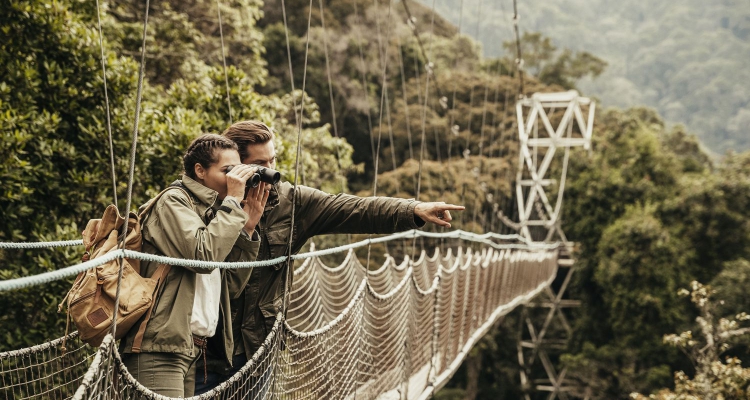
- Nyungwe Canopy Walkway: Located in Nyungwe Park, the Nyungwe Canopy Walkway offers beautiful views. A typical exploration of this 70-meter-high suspended bridge, which spans approximately 160 meters, typically requires approximately two hours.
- Diverse Flora: In Nyungwe Park, there are more than 1,068 flora that have been documented. Even orchids and mahogany are among the most prevalent trees. The majority of the flora in this protected area are medicinal herbs.
There is an abundance of exciting activities for travelers participating in Rwanda safari tours in Nyungwe Forest National Park.
Let us examine the most exceptional tourist activities in Nyungwe Park below.
- Chimpanzee Trekking in Rwanda: Nyungwe National Park is primarily known for its chimpanzee trekking, which is a thrilling experience that allows visitors to interact with the closest living relatives of humans, the chimpanzees.
The protected area is home to a variety of primate types and fauna, including vibrant avifauna, that can be observed during chimpanzee excursions. There is a one-hour time limit for travelers to observe primates.
- Birdwatching: It is difficult for visitors on Rwanda birdwatching excursions to forgo birding tours in Nyungwe Park. Most avifauna can be observed within Nyungwe Park’s numerous birding trails.
Expect to see the Great Blue Turaco, Bar-tailed Trogon, Dusky crimsonwing, and Yellow-eyed black flycatcher, among others.
- Taking a Nyungwe Forest Canopy Walk: The Nyungwe Forest canopy walk provides you with breathtaking views of Nyungwe Wood and beyond.
It is exceedingly uncommon to fail to observe charming primates, including the Black and White Colobus, among the canopy of the trees while on the walk. At certain locations, Lake Kivu is also visible, which offers various aquatic sports and is known for its tranquil beach environment.
- Colobus Monkey Tracking: Two habituated groups of Colobus monkeys are available for primate excursions inside Nyungwe.
- Nature excursions in Nyungwe Forest:
Visitors are afforded an exceptional opportunity to investigate this biodiverse park through forest excursions.
Gishwati Mukura National Park
Rwanda’s dedication to preserving the environment is evident in the fact that Gishwati Mukura is one of its most recent parks, created in 2015. Western Rwanda is the location of this park.
There are two distinct types of jungles: Gishwati and Mukura.
Previously, these two forests were exploited; however, they are currently undergoing significant restoration efforts, which are ensuring that they serve as secure havens for an increasing number of fauna.
Tourists seeking to explore Gishwati-Mukura may engage in a variety of activities, such as bird viewing and forest walks, during which they may observe Chimpanzees, Golden monkeys, and a variety of avifauna.
The Optimal Time to Visit Rwanda’s National Parks
While travelers on African excursions in Rwanda have the freedom to explore the national parks at any time of year, the dry months of June through September and December through February are the most suitable.
The dry months in Rwanda are typically characterized by low rainfall, which results in drier and more tranquil hiking trails for chimp tracking and gorilla excursions. Akagera Park also offers exceptional game-viewing excursions during this time.
In Rwanda, the long rainy season is from March to May, while the brief rainy season is from October to November.
Travelers are usually granted discounts by the majority of lodges in this nation during the off-season. It is possible to engage in gorilla trekking in Volcanoes National Park during this season.
Packing List for Rwanda Safari Tours in the Safari Parks
As you explore Rwanda’s numerous national parks, the packing list is straightforward and budget-friendly.
When visiting Rwanda’s national parks in East Africa, adhere to the following packing list:
- A camera for photography purposes
- Lightweight hiking footwear
- Raincoat
- A knapsack
- It is advisable to wear safari clothing that is friendly, such as khaki.
- Personal necessities
- Repellent for insects
- Glasses for sun protection
- A sunhat
- A garment that prevents cold
- Bottle of water
FAQs Regarding Rwanda’s National Parks
How Many National Parks Are There in Rwanda? | How Many Parks Are There in Rwanda?
In Rwanda, there are four game reserves. The following are included: Giswati Mukura National Park, Nyungwe Park, Akagera Park, and Volcanoes National Park.
In Rwanda, Which National Park Is the Most Frequently Visited?
Volcano National Park is Rwanda’s most frequently visited park, and it is renowned for its gorilla trekking excursions and golden monkey tracking expeditions across the whole world.
In Rwanda, Which Park Is the Largest?
In Rwanda, Akagera National Park is the greatest park. East of the nation, Akagera Park spans over 1,122 square kilometers and shares a border with Tanzania. The distance from Kigali city is approximately 3-4 hours by car.
In Rwanda, What Are the Challenges That National Parks Are Currently Facing?
A lack of finances, habitat loss, and insufficient personnel to monitor wild fauna in Rwanda’s national parks—all of which are under the Rwanda Development Board—are the primary challenges that the management of these protected areas is currently confronting.
Together with International organizations, the Rwandan government has made restoring wild fauna a national priority since the genocide in 1994. Additionally, poaching is no longer a significant concern in the majority of protected areas in this nation.
In Rwanda, What Is the Name of the Recently Established National Park?
The Giswati Mukura National Park is Rwanda’s most recent park. This rainforest park was gazetted in 2016 with the primary objective of protecting the Giswati and Mukura forests. Covering an approximate 32 km² area, it is also Rwanda’s smallest park, offering chimpanzee trekking and bird watching as its main activities.
Which Game Park Is Located in Rwanda?
In Rwanda, there are four game reserves. Some of these parks are Akagera Park, Nyungwe Park, Volcano Park, and Giswati Mukura Park.
Additionally, Rwanda’s national parks provide travelers with the opportunity to establish a connection with the natural world, in addition to providing wildlife encounters.
Rwanda parks are available for those who are interested in mountain gorilla trekking, chimp tracking, golden monkey trekking, bird watching, or wilderness safari excursions in the African savannah plains.
The national parks each have their own distinctive features, i.e., Volcanoes Park is renowned for its gorilla trekking safaris, Nyungwe Park for its chimpanzee trekking tours, and Akagera Park for its wildlife viewing safaris.
Please allow us to customize your African adventure to Rwanda, or you may review our most popular Rwanda gorilla safari packages and select one.
 >
>